CNC Automation Solutions for Metal Manufacturing.
When should you consider automation in CNC production?
For CNC manufacturers, automation is not about replacing people. It is about using people, machines and production time better, and about building a production setup that keeps delivering, shift after shift.
The right automation solution helps production managers achieve more stable output and better OEE, and supports business owners with stronger machine utilisation, a clearer return on investment, and long-term competitiveness.
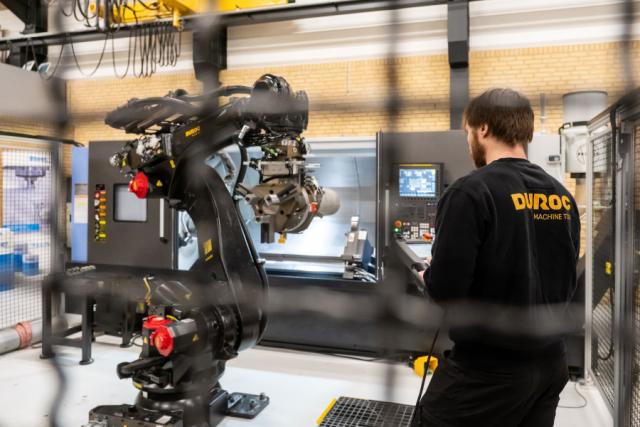
1. When your CNC machines are waiting for operators.
One of the clearest signs that automation deserves a closer look is when machines stand still because operators are occupied elsewhere.
In many workshops, skilled operators spend valuable time loading and unloading parts, opening and closing doors, cleaning workpiece fixtures, moving pallets, or waiting for the next operation. These tasks are necessary, but they rarely require the full skill level of an experienced machinist, and every minute of it shows up directly in your uptime figures.
Automation solutions such as robot machine tending, cobots, pallet systems or bar feeders reduce this waiting time and keep machines cutting more consistently.
For production management, this translates into better spindle uptime and a more predictable OEE. For the business, it means the investment in the machine itself is finally being used to its full potential.
Learn more about your different automation solutions possibilities.
2. When you have repeatable parts or part families.
Automation performs best when there is a degree of repeatability in what you produce.
3. When setup and changeover time limits your capacity.
For many CNC workshops, the real constraint is not machining time itself. It is everything that happens around it.
4. When skilled labour is hard to find.
Most metal manufacturing companies face the same challenge: experienced machinists are difficult to recruit, and even harder to keep.
Automation cannot replace machining knowledge, but it can help you put that knowledge to better use. Instead of tying up skilled operators with repetitive handling, automation lets them supervise more machines, optimise programs, refine cutting data and support quality — work that actually grows the business.
This is especially relevant for companies that want to grow capacity without growing headcount at the same rate. Automation also supports a working environment where operators take on more responsibility and develop their skills, while repetitive and physically demanding tasks are handled more efficiently.
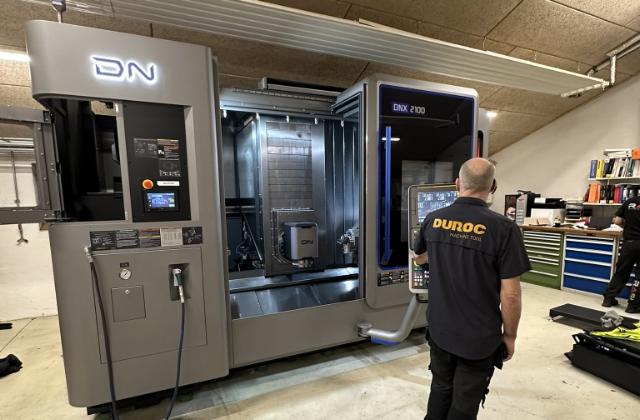
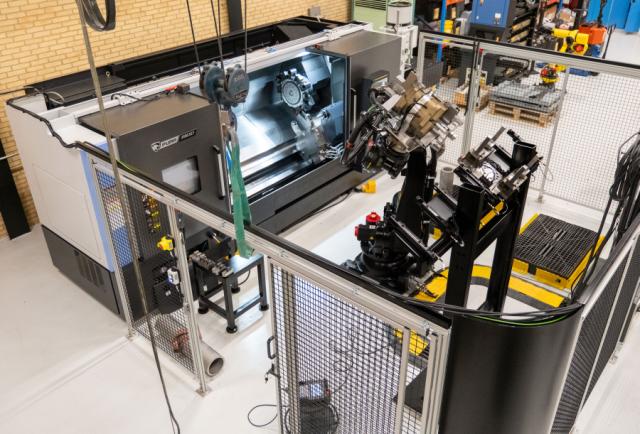
5. When you want to run unmanned or lights-out production.
Unmanned production is one of the strongest business cases for automation, but it requires the process to be ready for it first.
- Stable cycle times
- Predictable tool life
- Reliable clamping and workpiece positioning
- Good chip control
- Repeatable quality results
- Clear routines for tool monitoring and inspection
6. When quality depends too much on manual routines.
Manual handling is often a hidden source of variation, and variation is expensive.
7. When you want better control of cost per part.
Automation should always be connected to business value.
8. When you are investing in new CNC machines.
The best time to plan automation is often before a new CNC machine is even installed.
When the machine, automation, workholding, tooling and layout are planned together from the start, the result is stronger and more future-proof. Space, interfaces, robot access, safety zones, chip handling and future expansion can all be built in from day one, rather than retrofitted later as a compromise.
If you are planning a new machining centre, turning centre or mill-turn machine, automation should be part of that conversation early, even if it is implemented in stages.
Automation doesn't have to start big.
Many business owners assume automation means a large, complex robot cell. That is not always the case.
- A bar feeder for turning
- A cobot for machine tending
- A robot table solution
- A pallet pool for milling
- A zero-point clamping system
- A structured fixture concept
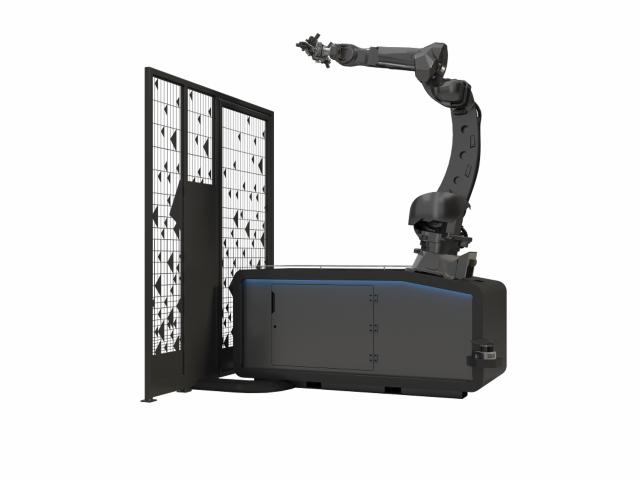
Automation as part of a complete machining strategy.
Automation should never be treated as a standalone system. It performs best when it is connected to the full machining process, including:
- CNC machines
- Workholding and clamping
- Cutting tools and tool holders
- Measuring instruments
- Software and machine control
- Service and support
- Operator training
When is the right time to consider automation?
Automation is worth considering when your current production flow is limiting your performance.
That may be when machines wait for operators, when skilled labour is difficult to find, when changeovers take too long, or when you want to run more hours without adding more manual work.
The right time is not necessarily when everything is perfect. It is when you can identify a clear challenge that automation can solve, and when you are ready to build a more predictable, scalable process around it.
For metal manufacturing companies running CNC machines, automation remains one of the most practical ways to increase uptime, improve capacity, control cost per part, and prepare production for the future.
Talk to Duroc Machine Tool about CNC automation.
Duroc Machine Tool helps manufacturing companies across the Nordic and Baltic regions with machines, automation, tools, service and support — all from one partner.
Through Duroc Machine Tool Automation, we design and deliver automation solutions built around real production needs. From machine tending and robot loading to pallet systems, workholding concepts and complete CNC production cells. Our applications engineers have the expertise to design, develop and install tailored automation solutions that fit your production, not the other way around.
If you are considering automation, we can help you evaluate where it makes sense, what level of automation fits your production, and how to build a solution that supports uptime, quality, cost per part and long-term competitiveness.
Do you need advice?
If you have any questions, don't hesitate to contact us.

CNC Automation Solutions for Metal Manufacturing
When should you consider automation in CNC production? Learn when machine tending, robot loading, pallet systems and unmanned production can improve uptime, capacity and cost per part in metal manufacturing.

Intelligent Material Handling: A Smarter Investment for Modern Manufacturing.
New machine tools often receive the most attention when productivity improvements are discussed. Yet many production facilities still lose valuable time every day because of inefficient manual material handling.

DN Solutions DHF 5500. High Productivity and Exceptional Precision in 5-Axis Horizontal Machining.
The new DHF 5500 from DN Solutions is a 5-axis horizontal machining center developed for manufacturers who refuse to compromise – on precision, uptime, or capacity.
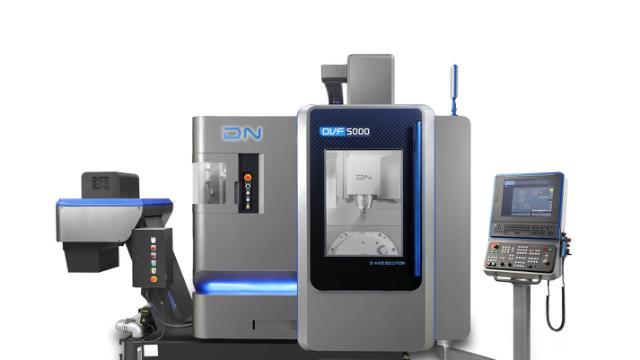
Comparison of DVF 5000 1st Generation and DVF 5000 2nd Generation
With the introduction of the DVF 5000 2nd Generation, DN Solutions has taken their popular 5-axis machining center to the next level. In this article, we highlight the key differences between the original DVF 5000 and the new 2nd Generation model.